

Written by: Astrophyzix Digital Observatory
Near-Earth Object Close Approach Report — 13–16 March 2026
📌 Cited by Innovatopia News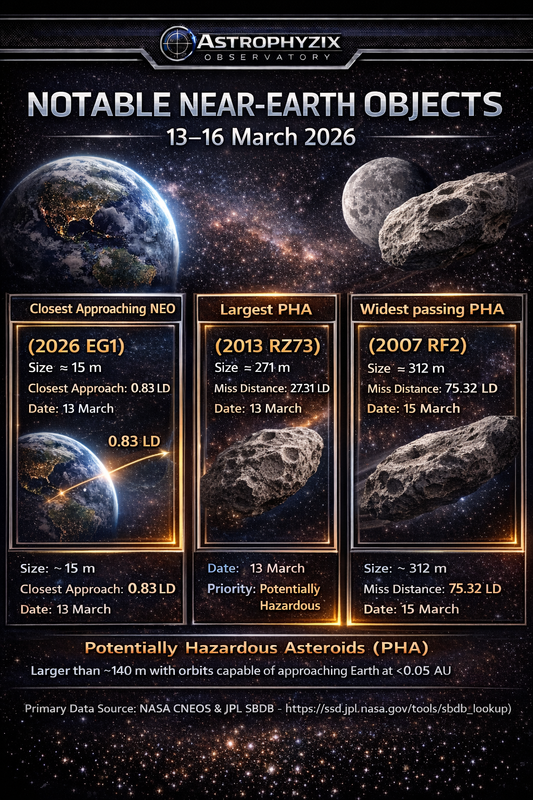
Your Reliable Weekly NEO Report
The following Near-Earth Object (NEO) monitoring report summarises asteroid flybys occurring between 13 March and 16 March 2026. Data is compiled from the NASA Jet Propulsion Laboratory Small-Body Database and associated planetary defence monitoring systems.
Distances are expressed in Lunar Distances (LD), where 1 LD = 384,400 km. This unit provides an intuitive scale for evaluating asteroid flybys relative to the Earth–Moon system.
During this monitoring interval 25 catalogued Near-Earth Objects make relatively close approaches to Earth. None of the objects present any impact risk. Several larger asteroids are formally classified as Potentially Hazardous Asteroids (PHAs), however all remain safely tens of lunar distances from Earth.
Overview of the 13–16 March 2026 Near-Earth Object Approaches
Between 13 and 16 March 2026, multiple Near-Earth Objects (NEOs) will pass Earth at distances ranging from less than one lunar distance to over ninety lunar distances. All objects in this dataset are catalogued and tracked by the NASA Center for Near-Earth Object Studies (CNEOS) and the NASA/JPL Small-Body Database. These flybys represent routine celestial events resulting from the natural orbital dynamics of small Solar System bodies. Continuous monitoring programs ensure that even relatively small objects are detected, catalogued, and tracked with increasing precision.
The closest upcoming object in this group is (2026 EG1), a small asteroid estimated to be approximately 15 metres in diameter. It will pass Earth at a distance of about 0.83 lunar distances (LD), or roughly 319,000 km. While this distance is closer than the Moon’s orbit, it still represents a safe margin in orbital terms. Objects of this size would typically disintegrate in Earth’s atmosphere if they were on an impact trajectory, similar to many meteoroids that produce bright fireballs.
Overall, the dataset illustrates the diversity of NEO flybys during a typical monitoring window. Sizes range from only a few tens of metres to nearly a kilometre across, and velocities vary significantly depending on orbital geometry. Despite sensational headlines that sometimes accompany such events, none of these objects pose an impact threat during the listed approach window.
Closest Upcoming Object: (2026 EG1)
The asteroid (2026 EG1) represents the closest Earth approach within this monitoring period. With an estimated diameter of around 15 metres, it belongs to the class of small Near-Earth Objects that are frequently detected by modern survey systems such as Pan-STARRS and the Catalina Sky Survey.
Although its approach distance of 0.83 LD may appear close, this is well within the range of normal NEO flybys. Objects smaller than roughly 20 metres are relatively common in near-Earth space, and improved survey capabilities now allow astronomers to identify many of them before or shortly after close approaches. Monitoring these objects helps refine orbital models and contributes to ongoing planetary defense research.
- Estimated Size: ~15 metres
- Orbit Classification: Near-Earth Object (NEO)
- Relative Velocity: ~9.62 km/s
- Closest Approach Distance: ~0.83 Lunar Distances
- Hazard Classification: Not Hazardous
Notable Objects in the Current Approach Window

While none of the listed objects represent an impact risk, several are considered notable from a scientific or monitoring perspective. These objects stand out due to their size, classification, or approach geometry.
2013 RZ73
- Estimated diameter of approximately 271 metres
- Classified as a Potentially Hazardous Asteroid (PHA)
- Approach distance: 27.31 LD
Objects are classified as Potentially Hazardous Asteroids when they are larger than roughly 140 metres and have orbits that can approach Earth within 0.05 astronomical units. This classification does not indicate an impact threat during the current pass; it simply means the object is large enough and passes close enough to warrant long-term orbital monitoring.
2007 RF2
- Estimated diameter of about 312 metres
- Also classified as a Potentially Hazardous Asteroid
- Approach distance: 75.32 LD
Despite its PHA designation, this asteroid will remain extremely distant from Earth during this pass. The PHA classification is purely a precautionary category used by astronomers to prioritize monitoring.
394392 (2007 EP88)
- Largest object in this dataset at roughly 911 metres
- Approach distance: 72.14 LD
- Relative speed: 34.03 km/s
Although significantly larger than most objects in this list, its distance during the flyby is very large in planetary terms. This object is scientifically interesting primarily because larger NEOs provide valuable data for orbital modelling and population statistics.
Understanding Lunar Distance Measurements
Close approaches are often expressed in Lunar Distances (LD), a convenient astronomical unit equal to the average distance between Earth and the Moon—approximately 384,400 kilometres. A flyby at one lunar distance means the object passes roughly at the same distance as the Moon’s orbit.
Objects passing within several lunar distances are still considered extremely safe unless orbital calculations indicate otherwise. Planetary defense systems rely on precise orbital measurements derived from telescopic observations and radar data to determine whether any future trajectories could pose a risk.
Why Close Approaches Are Scientifically Valuable
Close flybys of NEOs are not merely catalogued for hazard monitoring; they also provide valuable scientific opportunities. When an asteroid passes relatively near Earth, astronomers can obtain improved measurements of its orbit, size, shape, rotation, and surface properties.
Radar observations from facilities such as Goldstone can sometimes produce detailed images of these objects, revealing irregular shapes, binary systems, or surface features. These observations improve our understanding of the population of small bodies that inhabit near-Earth space and contribute to long-term planetary defense strategies.
A Note on Online Misinformation
Near-Earth Object flybys frequently attract exaggerated claims on social media and video platforms. It is common to see sensational headlines suggesting that an asteroid is “skimming Earth” or “barely missing the planet,” even when the object is tens of lunar distances away.
Many clickbait videos rely on misunderstanding or misrepresenting publicly available data. They may omit critical context such as the true distance of the object, its hazard classification, or the uncertainties involved in orbital calculations. This can lead to unnecessary public concern about events that pose no real risk.
Readers are strongly encouraged to verify asteroid information using official scientific data sources. Reliable platforms include:
- NASA Center for Near-Earth Object Studies (CNEOS)
- NASA/JPL Small-Body Database
- Astrophyzix Observatory
These databases provide verified orbital data, hazard classifications, and continuously updated tracking information. Unlike speculative content or sensational videos, these sources are maintained by professional researchers and institutions dedicated to planetary science and impact monitoring.
Summary of Offical Tracking Data
The 13–16 March 2026 monitoring window includes a diverse set of Near-Earth Objects ranging from small meteoroid-scale bodies to asteroids approaching a kilometre in diameter. The closest object, (2026 EG1), will pass within one lunar distance but poses no hazard. Larger objects such as 2013 RZ73 and 2007 RF2 are classified as potentially hazardous purely due to their size and orbital characteristics, not because of any current impact threat.
Continuous monitoring by professional survey programs ensures that such objects are catalogued, tracked, and analyzed long before any potential future risk could arise. This ongoing work forms the backbone of modern planetary defense and allows scientists to provide reliable information about the dynamic environment of near-Earth space.
Closest Approach Data Summary
- Total NEO flybys recorded: 25
- Closest pass: 2026 EG1 at 0.83 LD
- Largest object: 394392 (2007 EP88) ~911 m
- Fastest relative velocity: 394392 (2007 EP88) at 34.03 km/s
- Potentially Hazardous Asteroids detected: 2
- Impact risk: None
Near-Earth Object Flyby Table
| Object | Date | Estimated Size | Orbit | Speed | Miss Distance | Hazard |
|---|---|---|---|---|---|---|
| 2026 EG1 | 13 Mar | 15 m | NEO | 9.62 km/s | 0.83 LD | No |
| 2026 EC1 | 15 Mar | 18 m | NEO | 12.51 km/s | 4.01 LD | No |
| 2024 CW2 | 15 Mar | 58 m | NEO | 7.77 km/s | 4.43 LD | No |
| 2007 EG | 15 Mar | 53 m | NEO | 7.77 km/s | 4.46 LD | No |
| 2026 EJ2 | 13 Mar | 43 m | NEO | 17.10 km/s | 12.74 LD | No |
| 2026 CR3 | 16 Mar | 91 m | NEO | 9.09 km/s | 19.45 LD | No |
| 2013 RZ73 | 13 Mar | 271 m | NEO | 20.06 km/s | 27.31 LD | PHA |
| 394392 (2007 EP88) | 16 Mar | 911 m | NEO | 34.03 km/s | 72.14 LD | No |
| 2007 RF2 | 15 Mar | 312 m | NEO | 14.20 km/s | 75.32 LD | PHA |
Close Approach Analysis
The closest object during this monitoring window is asteroid 2026 EG1, which passes Earth at a minimum distance of 0.83 lunar distances, or approximately 319,000 kilometres. This places the asteroid slightly closer to Earth than the average orbital distance of the Moon. Despite the proximity, the object is relatively small, with an estimated diameter of roughly 15 metres. Objects in this size range would typically disintegrate in the upper atmosphere if they were to enter Earth's atmosphere, similar to the Chelyabinsk meteoroid observed in 2013.
Several additional objects pass within five lunar distances, including 2026 EC1, 2024 CW2, and 2007 EG. Close approaches at this range are not uncommon and provide valuable opportunities for astronomers to refine orbital parameters and improve long-term trajectory models. Such observations contribute directly to the accuracy of planetary defence monitoring systems.
Two objects in this dataset meet the formal definition of Potentially Hazardous Asteroids (PHAs). These include 2013 RZ73 and 2007 RF2, both exceeding the approximate 140-metre diameter threshold used in hazard classification. However, their flyby distances remain tens of lunar distances from Earth, far beyond any region of impact concern.
The largest object within this report is 394392 (2007 EP88), estimated to be roughly 911 metres in diameter. Although this asteroid approaches Earth at a high velocity of approximately 34 km/s, its minimum approach distance exceeds 72 lunar distances, placing it safely beyond any potential hazard zone.
Planetary Defence Context
Near-Earth Object monitoring is conducted continuously by a global network of automated sky surveys and observatories. Major detection systems include Pan-STARRS, the Catalina Sky Survey, and the ATLAS early-warning network.
Orbital calculations and impact probability analyses are maintained by NASA’s Center for Near-Earth Object Studies (CNEOS) and the Jet Propulsion Laboratory Small-Body Database. These systems continually refine asteroid trajectories as new observations are obtained.
For the time interval covered in this report, no Near-Earth Objects present any impact threat to Earth.
Primary Data Source
- NASA JPL Small-Body Database Browser https://ssd.jpl.nasa.gov/tools/sbdb_lookup.html